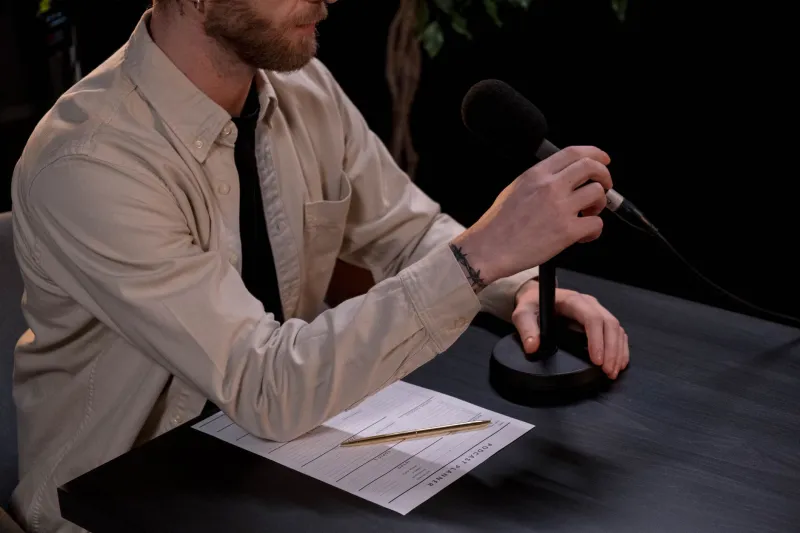
Second Mic, Second Thoughts: What a Follow-Up Episode Owes the Person Who Sat Down First

Photo: Asikironalio, CC BY 4.0, via Wikimedia Commons
The email usually arrives within seventy-two hours, and it usually starts the same way: Hey — can we talk about the episode?
Sometimes it's a factual error. Sometimes it's a sentence that sounded fine in a studio and reads differently once it's clipped into a thirty-second video with eight million views. Sometimes it's a family member who heard it in the car.
And increasingly, the answer to that email is another episode.
The follow-up has become the standard second act in audio and video media — a return visit where the guest gets to clarify, correct, walk something back, or explain what they meant. Done well, it's one of the most useful things a show can produce. Done badly, it's a press release wearing a podcast's clothes.
Here's the harder question nobody wants to ask: does the guest own the story once they've told it?
What the recording actually is
A taped conversation is a strange object. It's a moment that becomes a document. The person on the tape is a real person at a specific hour, and also a fixed artifact that will outlive that hour.
That gap is where all the trouble lives. A guest who says I'm fine in March may not be fine in June, and may be furious in November that March's version of them is now the search result. A guest who estimates a number wrong has a wrong number frozen in the record. A guest who was joking about the worst year of their life finds the joke separated from the context that made it survivable.
None of that is dishonesty. It's just what happens when a person becomes a clip.
Three kinds of return visits
The correction. A fact was wrong. A date, a name, a title, a timeline. This is the easiest case and the one shows should be most eager to fix — a correction is not a concession, it's maintenance. Adding a note to the episode description or recording a brief addendum costs the show almost nothing and costs the guest their reputation if ignored.
The clarification. Nothing was false, but the meaning got compressed. The guest said I wouldn't recommend it and the clip says I did it and I'd do it again. This is where a follow-up earns its keep, because it lets the guest add back the nuance the format stripped out.
The retraction. I shouldn't have said that, and I'd like it to not exist. This is the one that gets complicated, because it asks the show to treat the archive as editable — and the archive is not really editable. You can unpublish. You can't un-listen.
The edit dispute nobody wants to litigate
Most of the friction I see isn't about what a guest said. It's about where the cut landed.
A show's obligation is to represent the conversation honestly — not flatteringly. That means an edit that's technically accurate but contextually misleading is still a bad edit, even if every word is real. A producer who trims an eleven-second pause because it's "dead air" has just deleted the most important part of the answer.
But the inverse is also true: a guest who spent forty minutes saying something is not entitled to have thirty-nine of them erased because the remaining one hurt. The record is the record. Asking a host to bury it is asking them to lie by omission.
The fair middle ground is procedural, not emotional. Publish a clear corrections policy. Honor factual disputes fast and visibly. For disputes about interpretation rather than fact, offer the guest a right of reply rather than a right of deletion. And say all of this before the mic goes on, not after the clip goes viral.
So is the follow-up just the apology tour in a hoodie?
The cynical read is that the second episode has become the public relations circuit's favorite move: skip the written statement, skip the magazine interview, go straight to a friendly host who will let you explain yourself in a warm voice for fifty minutes.
There's something to that. A follow-up hosted by the same person who did the first interview is a soft landing by design. Audiences know it. That's why the return episode so often underperforms with the exact people it's aimed at.
But I don't think the format is the problem. The tell is what the second episode is willing to contain. A real follow-up includes the uncomfortable thing — the part where the host reads the clip back and asks about the exact sentence people are angry about. A PR exercise skips it in favor of a new, more sympathetic subject.
If the second episode never mentions the first one's hard part, it's not a follow-up. It's a reset button with a runtime.
What audiences should expect
Listeners are getting more sophisticated about this, and quickly. A few reasonable standards:
- Labels matter. If an episode is a clarification or a correction, say so in the first two minutes and in the description. Don't bury the premise in the last ten minutes.
- The host should be able to disagree with the guest on air. A follow-up where the interviewer agrees with everything is not journalism, it's a character witness statement.
- Facts get corrected in place, not only in a new episode. A note on the original is more useful than a new conversation that only the already-convinced will find.
- Guests get a right of reply, not a right of erasure. A show that quietly deletes a guest's own words — because the guest asked, or because the backlash was loud — is teaching every future guest that the tape is negotiable.
The follow-up episode isn't going anywhere. It's too useful, and honestly, too human. People change their minds. People get things wrong. People say the true thing before they're ready to defend it.
But the second mic should be a harder conversation than the first, not an easier one. If it's easier, everybody in the room already knows why.