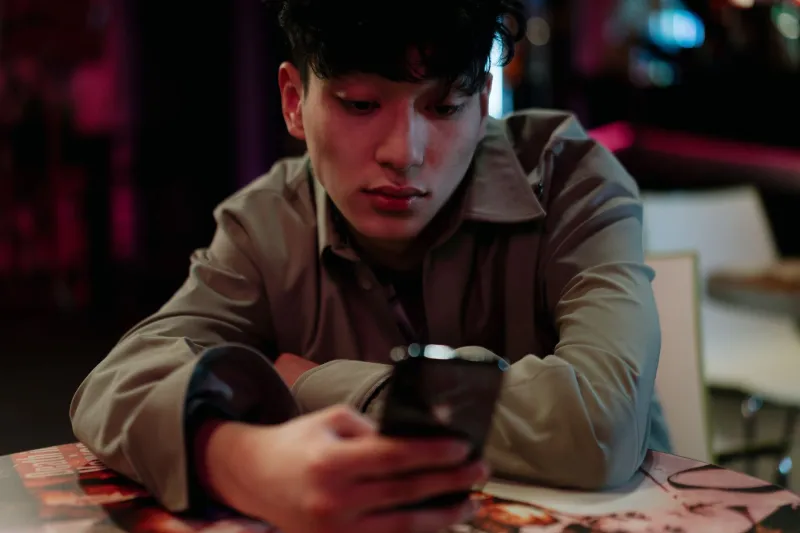
Swipe Right on Silence: How Texting Killed Our Ability to Actually Talk

There's a moment a lot of people recognize but nobody really talks about. You're sitting across from someone — a friend, a coworker, maybe even a partner — and the conversation hits a lull. Instead of sitting in it, riding it out the way humans have done forever, you reach for your phone. Not because anything important just happened. Just because the silence felt like a problem that needed solving.
That moment? It's worth paying attention to.
We are living through what communication researchers are calling a generational shift in how Americans process and deliver information to each other. And while the headlines tend to focus on social media addiction or screen time stats, the quieter story is this: we are genuinely losing our fluency in face-to-face conversation. Not just comfort — actual skill.
The Brain on Text
Here's the thing about texting and DMs that nobody tells you when you download the app: they are cognitively easier in almost every measurable way. You get time to think before you respond. You can edit. You can delete. You can ghost entirely if things get uncomfortable. The friction is gone, and that feels like a feature.
But that friction? It was doing a lot of work.
In live conversation, your brain is running several processes simultaneously. You're tracking tone, reading facial expressions, managing your own emotional response, deciding what to say next, and staying present all at once. It's demanding. And like any skill, if you stop practicing it, you get worse at it.
Dr. Sherry Turkle, a psychologist at MIT who has spent decades studying how technology shapes human connection, has made the case that even the presence of a phone on a table — not in your hand, just sitting there — degrades the quality of a conversation. People hold back. They go shallower. They keep one eye on the exit.
Now multiply that across fifteen years of smartphones, a pandemic that pushed most of our social lives onto screens, and a generation that literally grew up texting before they grew up talking. What you get isn't just distraction. It's atrophy.
Real People, Real Disconnect
Moni talked to a handful of people across different age groups about this, and the pattern was striking.
Jamila, 34, from Atlanta, described going back to work in-person after two years remote and feeling almost panicked in meetings. "I kept wanting to type my thoughts instead of just saying them out loud," she said. "I actually rehearsed things in my head like I was drafting a message. It was weird. It felt performative in a way that Slack never did."
Then there's Marcus, 22, a recent college grad in Chicago who admitted he's had entire relationship arguments over text that he genuinely doesn't know how to have out loud. "If she calls me to talk about something serious, my heart rate goes up," he said. "Not because I don't care. Because I don't know how to do it in real time without messing it up."
And it's not just young people. Donna, 58, from Phoenix, noticed something shifting in her book club — a group of women who've met monthly for over a decade. "We used to talk over each other, interrupt, laugh loud. Now half of us are checking our phones between chapters. The energy is different. It's more polite but less alive."
What Actually Disappears
This is the part that gets lost in the broader conversation about screen time: it's not just awkwardness we're dealing with. There are specific things that only exist in verbal, face-to-face exchange — things that text simply cannot replicate.
Spontaneity. The best moments in a real conversation are the ones nobody planned. The tangent that becomes the whole point. The laugh that breaks a tense moment. The pause that says more than any sentence could. Text flattens all of that.
Repair. When something lands wrong in a live conversation, you can catch it. You see the flinch. You adjust. In a text thread, that moment is gone before you know it happened, and now you're in a whole thing.
Presence. There is something neurologically different about being physically with someone and looking them in the eye. Oxytocin. Mirror neurons. The whole biological architecture of human bonding is built around proximity. Text gives you the content of communication without the experience of it.
Ambiguity tolerance. Real talk is messy. People trail off. They contradict themselves. They say the wrong word and mean the right thing. Learning to sit with that, to interpret generously, to not demand perfect articulation — that's an emotional skill. And we're outsourcing it.
The Conversation Comeback
None of this is a call to throw your phone in a river. That ship has sailed, and honestly, a well-timed meme still has its place. But there's a growing conversation — and yes, the irony of that phrasing is noted — about how to rebuild what we've been quietly letting go.
Some therapists are now explicitly coaching clients on what they call "conversation re-entry" — helping adults relearn how to tolerate the discomfort of real-time dialogue without defaulting to avoidance. Others are pointing to research showing that even short stretches of phone-free time with another person can meaningfully restore the sense of connection that people say they're missing.
The fix isn't complicated. It's just uncomfortable. Put the phone down. Ask the question. Sit in the pause. Let the conversation go somewhere you didn't plan.
That messiness you've been avoiding? That's actually the whole thing. That's where the real talk lives.